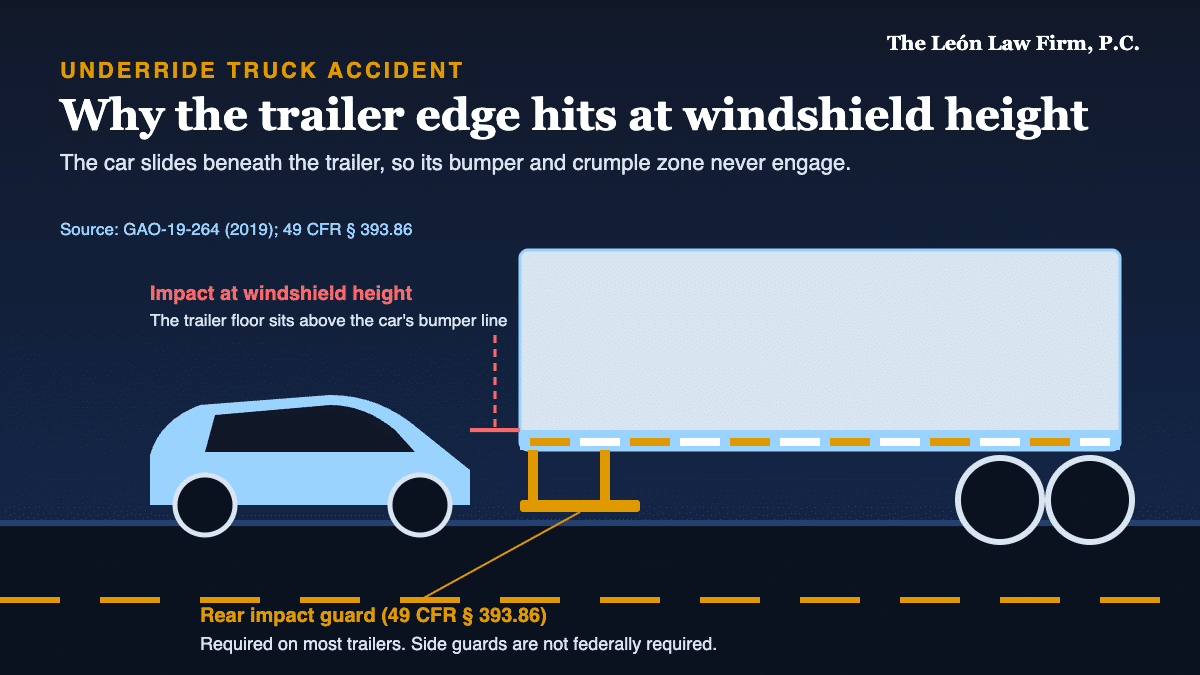
An underride truck accident happens when a passenger vehicle slides beneath the body of a tractor-trailer, under the rear of the trailer or into the open gap along its side, so that the trailer’s edge strikes the car at windshield height instead of bumper height. Because the car’s crash structure never engages, underride crashes cause a disproportionate share of severe head injuries and fatalities compared with other collisions of the same speed.
That’s the definition. What matters for a Texas family is why it happened, what should have prevented it, and who answers for it. This guide covers all three.
What Makes an Underride Crash Different
A car is engineered to absorb a collision through its front and rear structures. Bumpers, crumple zones, and the engine block soak up energy before it reaches the people inside. Seatbelts and airbags do the rest.
An underride crash bypasses that entire system. The bottom edge of a typical trailer sits well above a passenger car’s bumper. When the car goes underneath, the first thing to make contact is the windshield frame and roof, the weakest part of the passenger compartment. The result is what engineers call “passenger compartment intrusion,” and it’s why underride crashes can be fatal even at speeds that would otherwise produce moderate injuries.
The federal Government Accountability Office reviewed this issue in a 2019 report and noted that underride crashes are likely undercounted in national data because police crash forms don’t consistently record them. You can read that report here: GAO-19-264, Truck Underride Guards.
Underride vs. override
People sometimes confuse the two. In an underride crash, the smaller vehicle goes under the truck. In an override crash, the truck rides up over the smaller vehicle, often when a tractor-trailer rear-ends a car in stopped traffic. Both are catastrophic; both raise questions about following distance, speed, and driver attention. This post focuses on underride.
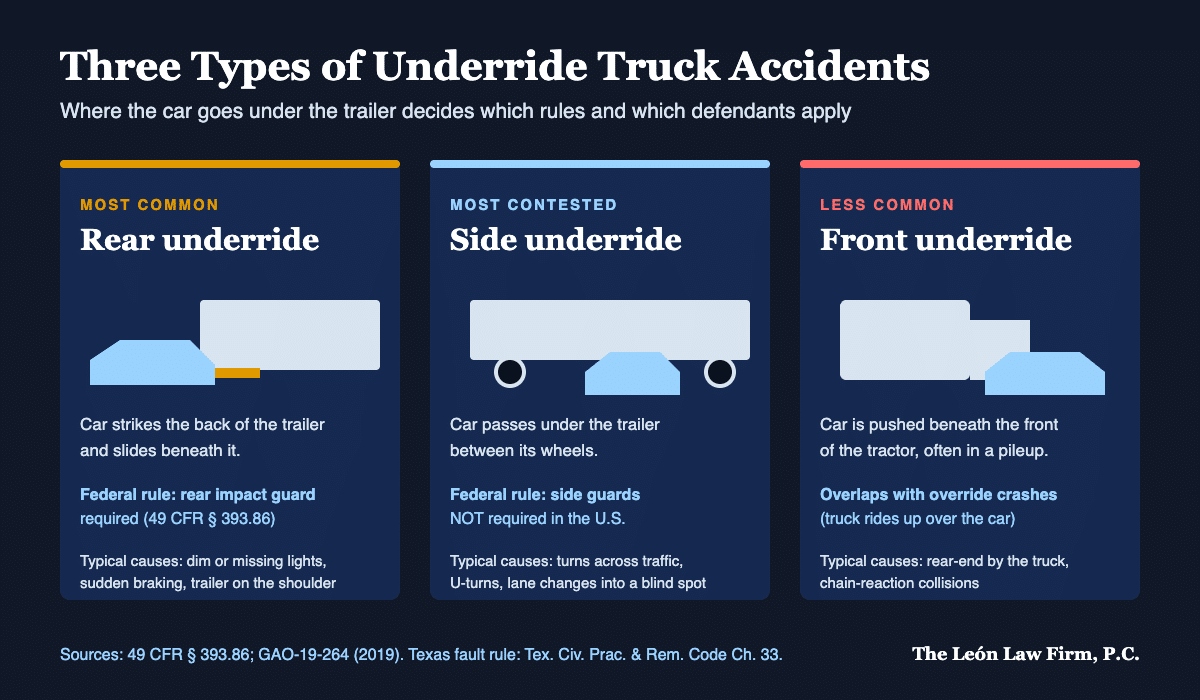
The Three Types of Underride Accidents
Rear underride
The most common form. A car strikes the back of a trailer and slides beneath it. Typical scenarios include:
- A truck stopped or moving slowly on a highway at night with dim, dirty, or missing rear lights and reflective tape
- A trailer backing across a roadway or blocking a lane while maneuvering
- Sudden braking by the truck in heavy traffic
- A trailer parked on or near the shoulder without warning devices
Rear underride is exactly what rear impact guards, the horizontal steel bars hanging below the back of a trailer, are designed to prevent.
Side underride
A car strikes the side of a trailer and passes beneath it between the wheels. This happens most often when a truck is:
- Turning across traffic at an intersection
- Making a U-turn or crossing a highway from a side road
- Changing lanes into a vehicle in its blind spot
- Stopped sideways across a roadway
Side underride is the more contested category. Federal rules do not currently require side guards on trailers, though safety advocates have pushed for them for years and some carriers install them voluntarily.
Front underride
Less common: a car is pushed beneath the front of a tractor, usually after being struck from behind by the truck or in a chain-reaction pileup. These crashes tend to overlap with override dynamics.
For a broader look at how each crash type happens, see the firm’s guide to the types of 18-wheeler accidents in Texas.
What Federal Law Requires, and What It Does Not
Trailers operating in interstate commerce must have a rear impact guard that meets federal specifications for height, width, and strength. The core rule is 49 CFR § 393.86, which sets out the equipment requirement. The performance standards for how those guards are built and tested live in the Federal Motor Vehicle Safety Standards (FMVSS Nos. 223 and 224).
Three points matter in a Texas underride case:
- A guard has to be present and intact. Guards get bent in loading-dock bumps, corrode, or are removed and never replaced. A damaged guard can fail exactly when it’s needed.
- Older trailers and certain trailer types are treated differently under the regulations. Whether a specific trailer was required to have a compliant guard is a fact question your attorney will run down.
- Compliance is a floor, not a ceiling. A guard that technically meets the minimum standard can still fail in an offset or higher-speed impact. Meeting the regulation does not automatically end the negligence question.
Side guards, as noted, aren’t federally mandated. That doesn’t mean a carrier can’t be negligent for how it operated a trailer without them. It means the case is built on driver and company conduct rather than an equipment violation.
Why Underride Crashes Happen
Regulations describe the hardware. Crashes are usually about people and decisions. Common contributing factors in Texas underride cases include:
- Conspicuity failures. Missing or degraded reflective tape, burned-out marker lights, or a trailer painted a dark color with nothing to catch headlights.
- Improper stopping and parking. Trailers left on shoulders, in travel lanes, or across roadways during breakdowns or deliveries without reflective triangles or flares.
- Unsafe turns and crossings. A tractor-trailer that pulls across a highway without enough gap gives oncoming drivers nowhere to go.
- Driver fatigue and distraction. Slow reactions, drifting, and abrupt braking are all linked to hours-of-service problems. We cover the rules in truck driver fatigue and hours-of-service violations.
- Maintenance failures. A bent or missing guard is a maintenance record waiting to be found.
- Speed differential. On highways where trucks move far slower than surrounding traffic, which is common on Texas interstates at night, closing speeds climb fast.
None of these excuse the passenger-car driver’s own responsibilities. But in most underride cases, the question is whether the truck was operated and equipped the way a reasonable carrier would have.
Who Is Liable for an Underride Truck Accident in Texas
Truck cases are rarely one-defendant cases. Depending on the facts, responsibility can reach:
- The truck driver, for negligent driving, improper stopping, or an unsafe turn.
- The motor carrier, both for its own conduct (hiring, training, dispatch pressure, maintenance) and for the driver’s negligence under Texas’s respondeat superior doctrine, which holds employers responsible for employees acting in the course and scope of their work.
- The trailer’s owner or lessor, if it’s a different company than the tractor’s operator, which is common in the freight industry.
- A maintenance contractor, if guard damage or lighting failures were missed or improperly repaired.
- A manufacturer, in cases where a guard failed despite being intact, raising a product-defect question.
- A shipper or broker, in narrower situations involving loading or dispatch decisions.
Sorting this out is the heart of the case. We go deeper on each party in who can be held liable after a truck accident. The practical point: identifying every responsible party early is how you make sure enough insurance coverage is on the table for injuries this severe.
Texas’s proportionate responsibility rule
Texas assigns a percentage of fault to everyone involved under Chapter 33 of the Civil Practice and Remedies Code. If the injured driver is found more than 50% responsible, they recover nothing; at 50% or less, their recovery is reduced by their share. Expect the carrier’s insurer to argue speed, following distance, or inattention on the car driver’s part. Evidence of the truck’s lighting, guard condition, and positioning is how that argument gets answered.
Evidence in an Underride Case, and Why Speed Matters
Underride cases are won and lost on physical evidence that does not wait around:
- The trailer itself. Guard condition, height, mounting, and any prior damage. Once a trailer is repaired or returned to service, that evidence is altered.
- Lighting and reflective tape. Photographed and measured before anything is cleaned or replaced.
- Electronic data. Modern tractors record speed, braking, and engine data. Electronic logging devices record the driver’s hours.
- Driver qualification and maintenance files. Federal rules require carriers to keep them; they show what the company knew.
- Scene evidence. Skid marks, gouges, debris fields, and the final rest positions of both vehicles.
An attorney sends a preservation (spoliation) letter to the carrier and its insurer immediately, putting them on notice that this evidence must be kept. If you’ve been through a truck crash, the first steps are laid out in what to do after a truck accident in Texas.
Damages and the Filing Deadline
Because underride injuries are so often catastrophic, these claims frequently involve future medical care, permanent impairment, and lost earning capacity, categories that require expert proof to establish. When the crash is fatal, surviving family members may bring a claim under the Texas Wrongful Death Act, and the estate may bring a survival action. The firm’s wrongful death attorneys handle those cases, and our guide to what a truck accident case is worth in Texas explains how damages are built.
The deadline is firm: Texas generally allows two years from the date of injury to file a personal injury lawsuit under Tex. Civ. Prac. & Rem. Code § 16.003, and two years from the date of death for wrongful death. Given how quickly trucking evidence disappears, waiting anywhere near that long is a serious mistake.
How The León Law Firm Approaches Underride Cases
The firm treats every truck case as a potential trial from the first day, because that’s what makes insurers take the demand seriously. In an underride case that means an early preservation letter, a prompt inspection of the trailer and its guard, retrieval of the truck’s electronic data before it’s overwritten, and a full accounting of every company that touched that trailer.
The León Law Firm represents truck accident victims across Texas, including the Houston area, from its Sugar Land office, in English and Spanish. You owe no attorney’s fee and no case expenses unless the firm recovers money for you.