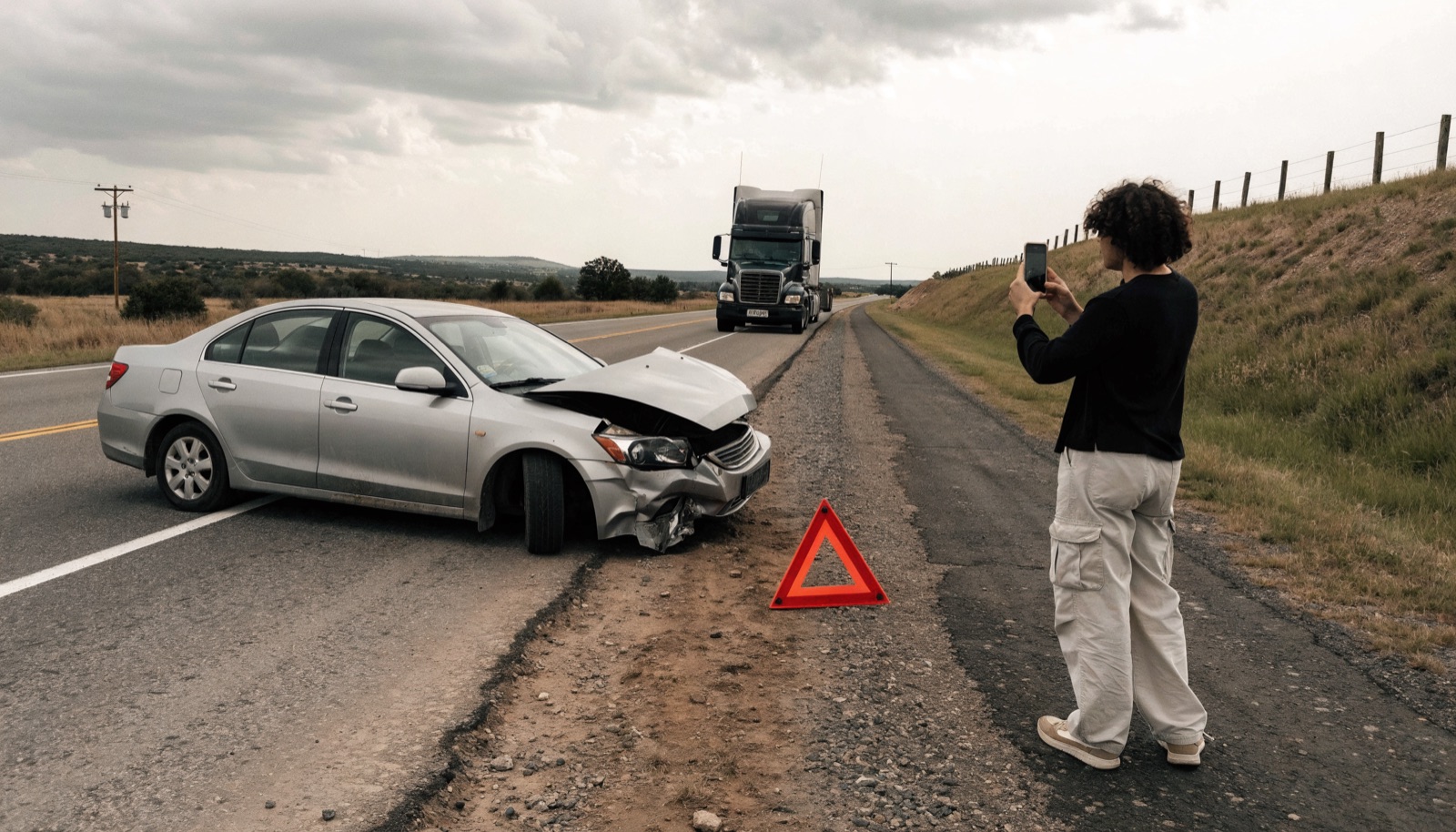
What to do after a truck accident comes down to five things, in order: get safe, get medical care, call the police, document the scene, and avoid talking to the trucking company’s insurance adjuster before you talk to a lawyer. Truck crash cases move fast on the other side: a carrier’s investigators can be at the scene within hours, so the choices you make in the first few days often decide how strong your claim is later.
An 18-wheeler crash is not a bigger version of a fender-bender. A fully loaded truck can weigh up to 80,000 pounds against roughly 3,500 to 4,500 pounds for a passenger car, and the company behind that truck has lawyers and insurance adjusters working the case before you’ve left the emergency room. This guide walks through what to do in the first minutes, the first days, and the first weeks after a wreck.
What to Do After a Truck Accident: First Steps at the Scene
The minutes right after a truck accident are chaotic, but a few simple actions protect both your health and your future claim.
Move to safety if you can. If your vehicle is drivable and you’re not seriously hurt, move it out of traffic. If you can’t move safely, stay where you are and turn on your hazard lights.
Call 911 immediately. Report the crash and ask for both police and medical assistance, even if injuries seem minor. A responding officer will document the scene and create the official crash report you’ll need later.
Exchange information, but keep it factual. Get the truck driver’s name, license number, and the name of the trucking company. Do not discuss fault, apologize, or speculate about what happened: just the facts needed to file a report.
Photograph everything you can. Vehicle damage from multiple angles, skid marks, road conditions, traffic signs, and visible injuries all matter. Photos taken in the first hour are often more valuable than anything gathered later, once damage has been cleared or vehicles moved.
Get the truck’s identifying numbers. The U.S. DOT number and carrier name are usually printed on the truck’s door or trailer. Write these down or photograph them. They identify exactly which company and insurance policy you’re dealing with.
Collect witness information. Names and phone numbers of anyone who saw the crash can matter enormously months later, when memories fade and the trucking company’s version of events doesn’t match yours. An experienced 18-wheeler accident lawyer knows how to track down and preserve that testimony before it’s lost.
Get Medical Care Even If You Feel Fine
Adrenaline masks pain. Some of the most serious injuries from truck accidents (concussions, internal bleeding, soft-tissue damage, spinal injuries) don’t announce themselves right away.
See a doctor the same day, even if you refused transport at the scene. An emergency room visit or urgent care exam creates a medical record that ties your injuries directly to the crash date, which matters enormously if the trucking company later argues your injuries came from somewhere else.
Follow through on every recommendation. If a doctor orders imaging, physical therapy, or a follow-up appointment, keep it. Gaps in treatment give an insurance adjuster an easy argument that you weren’t really hurt, or that something else caused your pain.
Keep every record. Bills, discharge paperwork, prescriptions, and appointment summaries all document both your injury and your damages. Your attorney will need these to build your claim.
The Police Report and How to Get It
The police crash report is one of the most important documents in your case. It includes the responding officer’s observations, contributing factors, citations issued, and a diagram of the crash, often the first neutral account of what happened.
Get the report number at the scene. The responding officer can give you a case or reference number before leaving. You’ll need it to request the full report later, since it typically isn’t finalized for several days to a couple of weeks.
Request the report through the agency that responded. Depending on where the crash happened, that might be a local police department, county sheriff’s office, or the Texas Department of Public Safety. Most agencies offer an online request system.
Read it carefully once you have it. Errors happen: a wrong vehicle description, a misidentified party, an incomplete narrative. If something looks wrong, your lawyer can help you request a correction or gather additional evidence to clarify the record.
Evidence That Decides Truck Cases Disappears Fast
This is the single biggest difference between a car accident and a truck accident: the evidence that proves what really happened is often controlled by the trucking company, and it doesn’t last long.
Why Trucking Companies Move Fast
Large carriers deploy rapid-response teams to serious crash scenes, sometimes within hours. These teams aren’t there to help you. They’re there to gather evidence, interview witnesses while memories are fresh, and start building the company’s defense before you’ve even seen a doctor. By the time an injured person calls a lawyer weeks later, key evidence may already be gone.
The Records That Matter Most
Trucking companies and drivers generate records that can make or break a case, but most of them aren’t kept forever:
- Electronic logging device (ELD) data. ELDs are federally required for most commercial drivers under 49 CFR Part 395 and record driving time, speed, and hours-of-service compliance.
- Dash-cam and in-cab camera footage, which many fleets record over on a rolling basis, sometimes within days.
- Maintenance and inspection logs, which can reveal whether brakes, tires, or lights were serviced, or ignored.
- Hours-of-service records. Federal rules limit property-carrier drivers to 11 hours of driving after 10 consecutive hours off duty, cap the on-duty window at 14 hours, require a 30-minute break after 8 cumulative hours of driving, and impose 60/70-hour limits over 7 or 8 consecutive days under 49 CFR § 395.3. You can read the full FMCSA hours-of-service rules directly from the source.
- The driver’s personnel and training file, which can show a pattern of violations the company knew about.
Sending a Preservation Letter
Because carriers control most of this evidence, a formal legal notice, often called a spoliation or evidence preservation letter, tells the company it has a legal obligation to keep these records and not destroy them. The sooner that letter goes out after a crash, the more likely the evidence still exists to receive it. This is one of the fastest, most concrete ways a truck accident lawyer can protect your claim in the first days after a wreck.
Dealing With the Trucking Company’s Insurance
Within days of a serious crash, you can expect a call from an insurance adjuster representing the trucking company or its driver. They may sound friendly and sympathetic. Their job is still to minimize what the company pays.
Do not give a recorded statement. Adjusters often ask to record your account “for the file.” That recording can be parsed later for any inconsistency, any offhand comment, or any statement that can be twisted to suggest you weren’t badly hurt or were partly at fault.
Do not accept a quick settlement offer. An early offer made before you know the full extent of your injuries is designed to close the file cheaply, before you’ve had time to see specialists or understand your long-term prognosis.
Do not sign anything the adjuster sends you without a lawyer reviewing it first. Some documents authorize the release of your full medical history, far beyond what’s relevant to the crash.
Refer them to your attorney. Once you have legal representation, you can simply direct any insurance company contact to your lawyer’s office. That single step removes the pressure to say the wrong thing during a stressful moment.
Mistakes That Hurt Your Claim
Some of the most damaging mistakes after a truck accident happen with good intentions:
- Apologizing at the scene. “I’m sorry” can be misread later as an admission of fault, even when you’re simply expressing concern.
- Posting about the crash on social media. Photos, check-ins, or comments about how you’re feeling can be used to argue your injuries aren’t as serious as claimed.
- Waiting to see a doctor. A treatment gap is one of the easiest arguments an insurer makes to devalue a claim.
- Talking to the trucking company’s investigator without representation. Their team is trained to gather statements that help the company, not you.
- Missing the filing deadline. Texas generally requires a personal injury lawsuit to be filed within two years of the crash date under Tex. Civ. Prac. & Rem. Code § 16.003. There are limited exceptions, but you should never count on one applying to your case.
It’s also worth understanding how Texas’s comparative fault rule works before you say anything about who caused the crash. Texas law reduces your recovery by your percentage of fault and bars recovery entirely if you’re found more than 50% responsible, so an offhand comment at the scene can matter more than it seems.
When to Call a Lawyer
The honest answer: as early as possible. You don’t need to have every detail figured out before reaching out. You need to reach out before evidence disappears and before you say something to an insurer that limits your options.
A lawyer can send preservation letters for ELD data, dash-cam footage, and maintenance records while they still exist. They can identify potential sources of recovery, including the trucking company’s federally required minimum liability coverage: $750,000 for most interstate freight carriers under 49 CFR § 387.9, and higher for hazardous materials haulers. They can also explain how the truck accident lawsuit process actually works in Texas, from investigation through resolution, so you’re not navigating it blind.
Because Texas courts often apply respondeat superior, holding an employer responsible for an employee driver’s negligence in the course and scope of employment, a lawyer investigates not just the driver’s actions but the company’s hiring, training, and maintenance practices too. That’s a very different investigation than a typical car accident claim, and it’s part of why truck accident compensation can involve more than one insurance policy.
If a loved one didn’t survive the crash, Texas’s Wrongful Death Act (Tex. Civ. Prac. & Rem. Code Ch. 71) gives certain family members the right to pursue a claim, and the same urgency around evidence and deadlines applies.