If you were hurt and someone else caused it, the next few weeks decide a lot. The personal injury claim process in Texas runs through six stages: getting medical care and documenting the injury, proving the other party’s negligence, handling the insurance company, calculating your damages, sending a demand and negotiating, and, if the insurer won’t pay fairly, filing a lawsuit before the two-year deadline in Tex. Civ. Prac. & Rem. Code § 16.003. Most claims settle without a trial. The ones that don’t are decided by a judge or jury.
That’s the whole map. The rest of this guide walks each stage in plain English, because the order you do things in, and the mistakes you avoid early, often matter more than anything a lawyer does later. If you’d rather talk it through now, you can speak with a Texas personal injury attorney for free, in English or Spanish.
For nearly 30 years, The León Law Firm has helped injured Texans, in English and Spanish, on a contingency basis. There is no fee unless the firm recovers money for you.
Key Takeaways
- It’s a negligence case. A Texas personal injury claim means showing someone owed you a duty of care, breached it, and caused your injuries and losses.
- Fault is shared by percentage. Texas uses “proportionate responsibility.” If you’re found more than 50% at fault, you recover nothing. Below that, your recovery is reduced by your share.
- The clock is two years. You generally have two years from the date of injury. Government defendants and some other situations have much shorter notice windows.
- Settlement is the norm, not the courtroom. Most cases resolve through a demand letter and negotiation. A lawsuit is the backstop, not the starting point.
- Documentation decides value. Every gap in your medical records and paperwork is leverage the insurance company uses to pay you less.
- You pay nothing up front. The León Law Firm handles claims across Texas on a contingency basis, with no attorney’s fee unless the firm recovers money for you.
How the Personal Injury Claim Process in Texas Works
Before the stages, it helps to see the shape of the whole thing. A personal injury claim in Texas is not a single event. It’s a sequence, and each step builds the one after it. Strong medical records make it easier to prove fault. Clear proof of fault makes the demand letter credible. A credible demand is what gets a fair settlement without a trial.
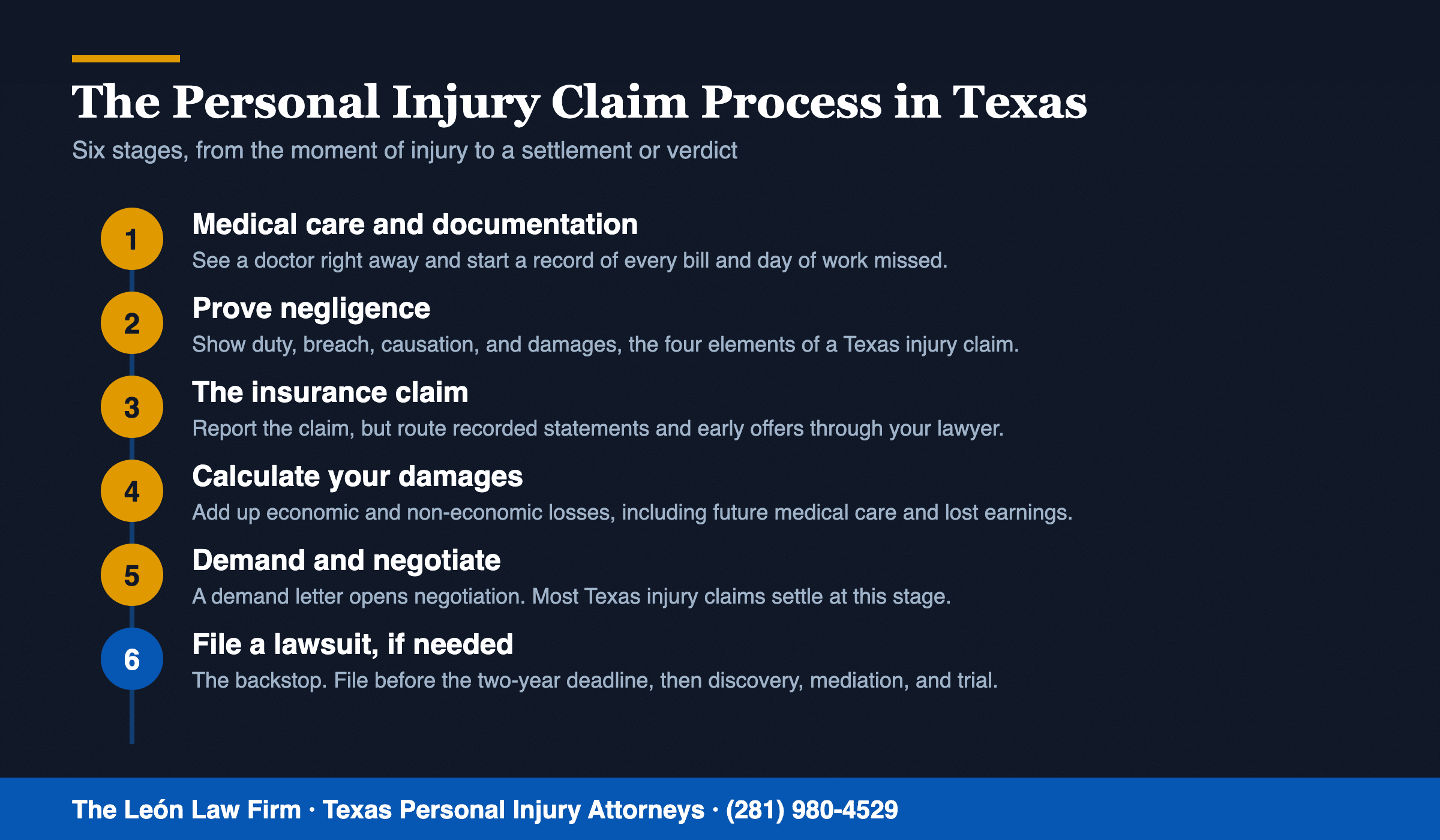
The whole process is driven by two questions the other side will ask at every step: were you really hurt, and did our client really cause it? Everything below is about answering those two questions with proof instead of your word alone.
Stage 1: Medical Care First, Documentation Second
Everything in a Texas personal injury claim eventually comes back to two questions: were you actually hurt, and did the other party cause it? Both are answered with records, and records start at the moment of injury.
See a doctor right away, even if you feel mostly fine. Soft-tissue injuries, concussions, and internal injuries often show up hours or days later. A gap between the accident and your first medical visit is the single most common argument insurers use to claim the injury came from somewhere else.
Then preserve the scene as best you can. Photos of vehicle damage, the hazard that caused a fall, visible injuries, and the surrounding conditions. Names and phone numbers of witnesses. A copy of any police report or incident report. If a business was involved, ask in writing that surveillance footage be kept, because many systems overwrite themselves within days.
Keep a simple file. Every bill, every appointment, every day of work you miss, every out-of-pocket expense. Write a few lines each week about pain levels and what you can’t do that you used to. This isn’t busywork. Later, it’s the difference between a claim built on memory and a claim built on proof.
Stage 2: Understanding What You Have to Prove
Texas personal injury law is built on negligence. To recover, you generally have to establish four things:
- Duty. The other party owed you a duty of reasonable care. Drivers owe it to everyone on the road. Property owners owe it to invited guests and customers. Employers owe it to workers.
- Breach. They failed that duty by running a red light, ignoring a known hazard, or skipping a required inspection.
- Causation. That failure actually caused your injury, not some unrelated event.
- Damages. You suffered real, measurable losses: medical bills, lost income, physical pain, and more.
Each of the firm’s practice areas is really a different fact pattern for proving those same four elements. A slip and fall on business property turns on what the owner knew about the hazard and when. A workplace injury may involve a non-subscriber employer or a third-party contractor. A defective product or drug claim can hold a manufacturer liable without proving carelessness at all. And in a commercial truck crash, several parties can share fault at once, which we break down in who can be held liable after a truck accident.
Proportionate responsibility: Texas’s “51% bar”
Texas is a modified comparative fault state. Under Chapter 33 of the Civil Practice and Remedies Code, a jury assigns a percentage of responsibility to everyone involved, including you. If your share is more than 50%, you recover nothing. If it’s 50% or less, your damages are reduced by your percentage.

Say a jury finds your total damages are $100,000 and you were 20% at fault for not wearing a seatbelt. You would recover $80,000. That example is illustrative, and every case is different, but the mechanism is exactly why insurers work so hard to push fault onto the injured person. Anything they can pin on you comes straight off the top of what they owe. It is also why motorcycle riders need this rule fought carefully, since bias against riders often shows up as an inflated fault percentage.
You can read the statute itself: Tex. Civ. Prac. & Rem. Code Ch. 33.
Stage 3: The Insurance Claim and the Recorded Statement Trap
Once you’ve been treated and gathered your records, the at-fault party’s insurer gets notified. Often they contact you first, sometimes within a day or two.
Here’s what people don’t expect: the adjuster is friendly, and that’s the job. Adjusters are trained to gather information that limits the company’s payout. Three things happen in almost every early call:
- They ask for a recorded statement. You are not required to give one to the other driver’s insurer, and doing so before you understand your injuries can lock you into answers you’ll regret.
- They ask you to sign a medical authorization. A broad release lets them dig through years of unrelated history looking for a pre-existing condition to blame.
- They float an early settlement offer. It feels generous when the bills haven’t arrived yet. It rarely is.
The right move is to report the claim, confirm the basic facts, and route everything else through your attorney. The Texas Department of Insurance publishes a plain-language auto insurance guide that explains how claims and coverage work, and it’s worth reading before you talk numbers with anyone. If you’ve already given a statement, don’t panic. Tell your lawyer exactly what was said so it can be addressed head-on.
Stage 4: Calculating Damages, What Your Claim Is Actually Made Of
“What is my case worth?” is the question everyone asks, and the honest answer is that it depends on the damages you can prove. Texas recognizes several categories.

Economic damages are the countable losses: medical expenses past and future, lost wages and lost earning capacity, property damage, and out-of-pocket costs tied to the injury.
Non-economic damages compensate for harm that doesn’t come with a receipt: physical pain and suffering, mental anguish, physical impairment and disfigurement, and loss of consortium for a spouse.
Exemplary (punitive) damages are different. They punish, rather than compensate, and Texas limits them to cases involving fraud, malice, or gross negligence proven by clear and convincing evidence, with statutory caps under Chapter 41. Drunk-driving crashes are one of the situations where they come up.
The firm’s guide to monetary damages in Texas injury cases goes deeper on how each category is proven. The short version: future medical costs and lost earning capacity are usually the largest numbers, and they’re the ones that require expert testimony to establish. This is also where a serious injury and a minor one part ways. A claim with a few weeks of soft-tissue treatment and a claim with a lifetime of care are not the same size, and the paperwork has to show why.
Stage 5: The Demand Letter and Negotiation
When your treatment has stabilized, meaning doctors can say what your future needs look like, your attorney assembles the claim and sends a demand letter to the insurer. It lays out liability, itemizes damages, attaches the supporting records, and states the amount demanded.
What follows is negotiation. The insurer responds with an offer, usually low. Your attorney counters with evidence. This back-and-forth can take weeks or months depending on the severity of the injury and how contested liability is. A typical exchange looks less like an argument and more like a slow trade of documents: the adjuster questions a medical bill, your lawyer sends the record that supports it, the adjuster questions the fault split, your lawyer sends the photos and the witness statement. Each round either moves the number or narrows what’s actually in dispute.
Two things determine how this stage goes: how well-documented the claim is (every gap in records is leverage for the insurer), and whether the insurer believes you’ll actually file suit. Insurers price in whether your lawyer will actually go to trial. That is the leverage a trial record buys you. For nearly 30 years, attorney Carlos A. León has proudly served injury victims across Texas, and the firm prepares every case as if it will be tried, which is exactly why the settlements it reaches do not need a courtroom.
Most personal injury claims end here, with a signed release and a settlement check. A settlement is final, so once you sign, the claim is closed even if a new medical problem appears later. That’s why the timing of the demand matters as much as its contents. When a fair number can’t be reached, you move to Stage 6.
Stage 6: Filing a Personal Injury Lawsuit in Texas
Filing suit doesn’t mean you’ll end up in a courtroom. It means the case moves onto a court’s calendar with rules and deadlines both sides have to follow. Broadly:
- Petition and answer. Your attorney files the petition in the appropriate county, and the defendant responds.
- Discovery. Both sides exchange documents, answer written questions under oath, and take depositions. This is the stage where the insurer’s own file gets opened up, too, and where a claim the adjuster dismissed on paper starts to look different under oath.
- Mediation. Texas courts routinely require it, and the Texas Judiciary supports mediation as a standard step. A neutral mediator works with both sides toward a settlement, and a large share of cases that survive to this point settle here.
- Trial. If nothing else resolves it, a judge or jury decides liability, assigns percentages of fault under Chapter 33, and awards damages.
We walk through the litigation stages in more detail in how a car accident lawsuit works in Texas. The mechanics are similar across injury types. What changes is the evidence.
The deadline that ends everything
Texas gives you two years from the date of injury to file most personal injury lawsuits under Tex. Civ. Prac. & Rem. Code § 16.003. Miss it and the claim is generally gone, no matter how strong it was. Our overview of the Texas statutes of limitations explains how that clock works.

Some situations are shorter or work differently. Claims against a city, county, or state agency require formal written notice within months, not years, under the Texas Tort Claims Act, and wrongful death claims run from the date of death rather than the injury. We cover the exceptions in how long you have to file a personal injury claim in Texas. If there is any chance a government entity was involved, treat the deadline as urgent from day one.
What Kind of Injury Case Do You Have?
The six stages above apply to almost every injury claim, but the details change with the kind of harm. Here is where each type fits, so you can go straight to the page that matches your situation:

- Vehicle crashes: car, truck, and motorcycle accidents all turn on driver negligence and, in commercial cases, on the company behind the driver.
- On the job: a workplace or oilfield injury can involve a non-subscriber employer or an outside contractor, which changes who pays.
- On someone’s property: a fall, a dog bite, or a store accident is a premises liability case built on what the owner knew.
- Defective products: a bad drug, device, or auto part is a product liability claim against the maker.
- Life-changing harm: a catastrophic injury or a birth injury needs future-care and lifetime-cost proof that ordinary claims don’t.
- Storm and property loss: if your claim is really about property damage or a denied hurricane insurance claim, that’s a different, first-party process from the injury claims in this guide.
When Someone Doesn’t Survive: Wrongful Death
If the injury proves fatal, the claim changes shape. The Texas Wrongful Death Act allows a surviving spouse, children, and parents to bring a claim for their own losses, and the estate may bring a separate survival action for what the deceased suffered before death. The proof is similar. The parties and the damages are different. The firm handles wrongful death claims with the care they require, and the two-year clock still applies. It just starts on the date of death.
What You Gain, and What You Risk Losing
It’s fair to ask whether you need a lawyer at all. For a minor fender-bender with no injuries, you may not, and any firm that tells you otherwise isn’t being straight with you. For anything involving real medical treatment, lost work, or disputed fault, the stakes are higher than most people realize, in both directions.
Here is what you stand to gain when the firm takes a case: the insurer stops calling you (all communication runs through the attorney, which ends the recorded-statement and early-offer pressure), evidence gets locked down fast (preservation letters go out before footage and logs disappear), damages are built by people who do this daily (future medical needs documented with the right experts, not estimated), and the demand is credible because it’s backed by the willingness to file and try the case.
And here is what you risk losing by waiting or going it alone. Miss the two-year deadline and the claim is gone for good, regardless of how badly you were hurt. Give a recorded statement early and a few careless words can shave thousands off the value. Sign a quick release and you’ve closed the door on the surgery you didn’t know you’d need. These aren’t scare tactics. They’re the ordinary ways a real claim quietly loses value, and every one of them is avoidable.
The León Law Firm represents injury victims across Texas from its Sugar Land office, in English and Spanish, on a contingency-fee basis. You owe no attorney’s fee unless the firm recovers money for you.
Frequently Asked Questions
Money and Settlements
What is the average personal injury settlement in Texas?
There isn’t a reliable average, and any site quoting one is guessing. Settlements are private and aren’t reported to a central database, and the range runs from a few thousand dollars for a minor soft-tissue injury to multi-million-dollar results for catastrophic harm. What drives the number is provable damages, meaning medical costs, lost income, and the severity and permanence of the injury, along with how clear liability is and how much insurance coverage exists.
How much of a $25,000 settlement will I get?
Your share is the settlement minus three things: the contingency attorney’s fee, the case expenses (records, filing fees, experts), and any medical liens or unpaid bills that must be repaid from the recovery. The exact percentages depend on your fee agreement and your medical situation, which is why you should ask for a written breakdown before you sign a release.
Can I recover money if the accident was partly my fault?
Yes, as long as you were 50% or less at fault. Under Texas’s proportionate-responsibility rule, your recovery is reduced by your percentage of fault, and you’re barred from recovering only if you’re found more than half responsible. Because a few percentage points can move real money, protecting your share of the fault picture is one of the most valuable things a lawyer does.
Timing and Deadlines
How long do I have to file a personal injury claim in Texas?
For most claims, two years from the date of the injury. Some situations are shorter. A claim against a city, county, or state agency requires formal written notice within months, and the exact window depends on the entity. Because the deadlines vary and a missed one usually ends the case, it’s safest to have your claim reviewed well before any deadline is close.
How long does it take to get money from a personal injury claim?
It depends on how long your medical treatment takes, because a claim usually shouldn’t settle until doctors can say what your future needs are. Straightforward claims with clear liability can resolve in months. Claims with serious injuries, disputed fault, or a lawsuit can take a year or more. Once a settlement is signed, funds typically arrive within a few weeks after the insurer issues payment and liens are resolved.
What happens if I miss the two-year deadline?
In most cases the claim is barred, which means a court won’t hear it and the insurer has no reason to pay. There are narrow exceptions, such as injuries to a minor or situations where the harm couldn’t reasonably have been discovered right away, but you should never count on one. If a deadline is anywhere close, treat it as an emergency and get advice immediately.
Working With a Lawyer
Do I need a lawyer for a personal injury claim?
Not always. For a minor incident with no real injuries, you may be fine handling it yourself. For anything involving surgery, lasting injury, lost income, or a fight over who was at fault, a lawyer usually changes both the process and the outcome, because the insurer treats a represented claim differently from an unrepresented one. A free consultation will tell you which kind of case you have.
How much does a personal injury lawyer cost in Texas?
At the León Law Firm, nothing up front. The firm works on a contingency-fee basis, so the fee is a percentage of the recovery and is owed only if the firm recovers money for you. The State Bar of Texas and free resources like TexasLawHelp.org can help you understand fee agreements before you sign one.
What are the chances of winning a personal injury lawsuit?
No honest lawyer can give you a percentage before seeing the evidence. The outcome turns on how clearly you can prove the other party’s negligence, how well your damages are documented, and how much fault the other side can assign to you under Texas’s proportionate-responsibility rule. A strong case is one built carefully from the first medical visit forward, which is exactly why the early stages in this guide matter so much.
Related Guides From Our Texas Injury Team
This pillar sits at the top of the firm’s personal injury resources. For the practice area that matches your crash or injury, start here:
- Vehicle crashes: car accident lawyer, truck accident lawyer, 18-wheeler accident lawyer, bus accident attorney, and our overview of vehicle accident representation.
- Go deeper: how a truck accident lawsuit works in Texas, the common types of car accidents, and truck accident compensation in Texas.
About The León Law Firm
The León Law Firm, P.C. is a Sugar Land, Texas, personal injury firm serving clients across the state. For nearly 30 years, attorney Carlos A. León has proudly served injury victims and their families, in English and in Spanish. The firm works on a contingency-fee basis: no attorney’s fee unless it recovers money for you.
We Help Injury Victims Across Texas
Wherever in Texas you were hurt, our team can help. We represent injury clients across Texas, including in Houston, Dallas, San Antonio, Austin, El Paso, and Corpus Christi, and in the communities around our Sugar Land headquarters.
The goal is not just a signed settlement. It is closing this chapter, whole and moving forward, knowing you did not leave anything on the table that was yours to claim.
Talk to a Texas Personal Injury Attorney
If you’ve been hurt and you’re not sure what comes next, start with a conversation. The León Law Firm offers a free consultation, in English or Spanish, and you pay no attorney’s fee unless the firm recovers money for you. Call (281) 980-4529, free and no obligation, or get my free case review.
This article is legal information, not legal advice, and reading it does not create an attorney-client relationship. Every case is different, so talk to a lawyer about your specific situation.
About the Author
Carlos A. León is the Founder and Lead Attorney of The León Law Firm, P.C. in Sugar Land, Texas. He earned his J.D. from the University of Houston Law Center in 1995 and his B.A. in Political Science from the University of Houston in 1991. He serves on the Boards of Directors of the Houston Trial Lawyers Association and the Texas Trial Lawyers Association, is a member of the State Bar of Texas and the American Association for Justice, and is admitted to practice in the U.S. District Courts for the Southern and Western Districts of Texas and the U.S. Fifth Circuit Court of Appeals. He was recognized by Super Lawyers in 2021. For nearly 30 years, he has proudly served injury victims across Texas, in English and Spanish. Read Carlos A. León’s full bio.