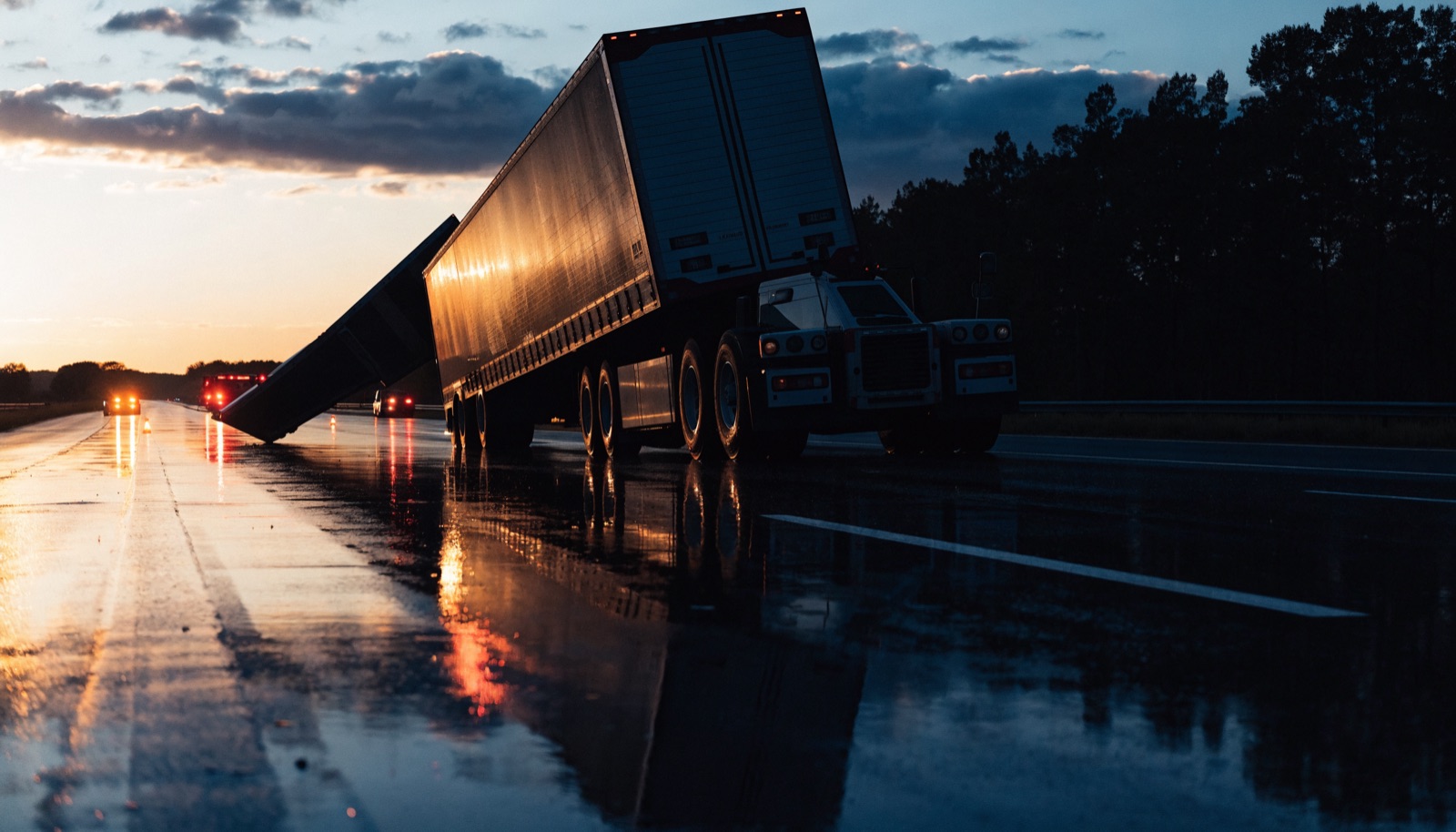
A jackknife accident happens when a truck’s trailer swings out and folds against the cab, usually because the trailer loses traction or outruns the tractor during hard braking. The result looks like a folding pocket knife snapping shut, which is where the name comes from. Jackknife crashes can span multiple highway lanes in seconds, and they’re almost never random; they usually trace back to a specific mechanical or human failure. Whether that failure can be documented in any given case depends on the evidence that survives and what the investigation uncovers.
A jackknife is just one entry on a longer list. If you’re not sure this is what happened in your crash, our overview of the types of 18-wheeler accidents in Texas can help you identify it. If you or someone you love was hurt in a jackknife crash specifically, understanding how and why it happened is the first step toward understanding who may be responsible. Our 18-wheeler accident lawyers walk families through exactly that process, and this guide breaks down the mechanics, the common causes, and who typically bears responsibility.
What Is a Jackknife Accident?
A jackknife accident gets its name from the visual: the tractor (cab) and the trailer bend at the coupling point until they form a “V,” the same way a folding knife’s blade snaps against its handle. Instead of tracking in a straight line behind the cab, the trailer swings out, sometimes 90 degrees or more, sweeping across adjacent lanes.
Because a fully loaded 18-wheeler can weigh up to 80,000 pounds compared to roughly 3,500 to 4,500 pounds for a typical passenger car, a jackknifing trailer doesn’t just block traffic. It can strike, crush, or drag vehicles caught beside or behind it. Some jackknife crashes stay contained to the truck itself; many others become multi-vehicle pileups.
The Physics Behind a Jackknife
In plain terms, a jackknife happens when the trailer’s momentum overtakes the tractor’s ability to control it. When a driver brakes hard, the tractor’s wheels can slow faster than the trailer’s wheels, especially if the trailer is empty or the road surface is slick. Once the trailer starts sliding sideways relative to the cab, there’s very little the driver can do to pull it back into line before the rig folds, which is why jackknifing tends to happen in an instant, with almost no warning to drivers nearby.
Common Causes of Jackknife Truck Accidents
Most jackknife accidents trace back to one or more of the following:
- Improper or hard braking. Slamming the brakes, rather than braking progressively, is one of the most common triggers, particularly with tandem-axle trailers.
- Speed on wet or icy roads. Excess speed for conditions reduces the traction margin a driver needs to brake safely, and Texas weather can turn a highway slick with little notice.
- Empty-trailer instability. An empty or lightly loaded trailer has less weight pressing its tires into the road, so its wheels can lock up and slide more easily than a fully loaded one.
- Brake maintenance failures. Worn brake linings, out-of-adjustment brakes, or mismatched braking power between the tractor and trailer axles can all make a truck harder to control under braking.
- Fatigue and inattention. A tired or distracted driver reacts late, brakes harder than necessary, or fails to adjust for road conditions in time. Federal hours-of-service rules exist specifically to reduce this risk. Our page on truck driver fatigue and hours-of-service violations covers how those rules work and how violations get uncovered.
- Cargo loading. Cargo that’s loaded unevenly, poorly secured, or improperly distributed front-to-back can shift the trailer’s center of gravity and make it far more prone to swinging out.
Why Jackknifes Are Rarely “Just an Accident”
Insurance adjusters and trucking companies often describe a jackknife crash as an unavoidable result of bad weather or a sudden hazard. Whether that explanation holds up depends entirely on what the evidence shows. That is why the investigation matters.
That’s why evidence matters so much in these cases. Electronic logging devices (ELDs), federally required for most commercial drivers under 49 CFR Part 395, can show how fast the truck was traveling, how hard the driver braked, and whether the driver was even legally allowed to be on the road at that hour.
Brake inspection records can reveal whether the carrier skipped required upkeep, and dash cam footage, when available, can capture the seconds before impact in a way no witness statement can match. Together, this evidence often turns “it was an accident” into a documented chain of decisions that caused it.
Who Is Liable for a Jackknife Truck Accident in Texas?
Liability after a jackknife crash depends on what caused the trailer to swing out in the first place, and more than one party can share responsibility.
The Driver
If the driver braked improperly, drove too fast for conditions, or was fatigued or distracted, the driver’s own negligence is often a central piece of the claim.
The Trucking Company
Under respondeat superior, a well-established rule of Texas common law, an employer can be held liable for an employee driver’s negligence committed in the course and scope of employment. A carrier can also face direct liability for negligent maintenance (failing to inspect or repair brakes) or negligent training and hiring (putting an unqualified driver behind the wheel). Federal rules require most interstate carriers to carry at least $750,000 in liability insurance, often the first source of recovery in a serious crash.
The Cargo Loader
When a shifting or improperly secured load caused or contributed to the jackknife, the company responsible for loading the trailer, which isn’t always the trucking company itself, can also bear liability.
Because Texas follows a modified comparative fault system under Tex. Civ. Prac. & Rem. Code Chapter 33, your own compensation can be reduced by your percentage of fault, and it’s barred entirely if you’re found more than 50% responsible. That makes it especially important to get an early, thorough investigation into exactly what went wrong.
What To Do If You’ve Been in a Jackknife Crash
The steps that protect your health and your claim after a jackknife accident are largely the same as after any serious truck crash: get medical attention, document the scene if you’re able, and avoid giving a recorded statement to the trucking company’s insurer before speaking with an attorney. Because ELD data and dash cam footage can be overwritten or deleted, time matters: the sooner a preservation request goes out, the more evidence survives. Our full guide on what to do after a truck accident in Texas walks through each step in order.