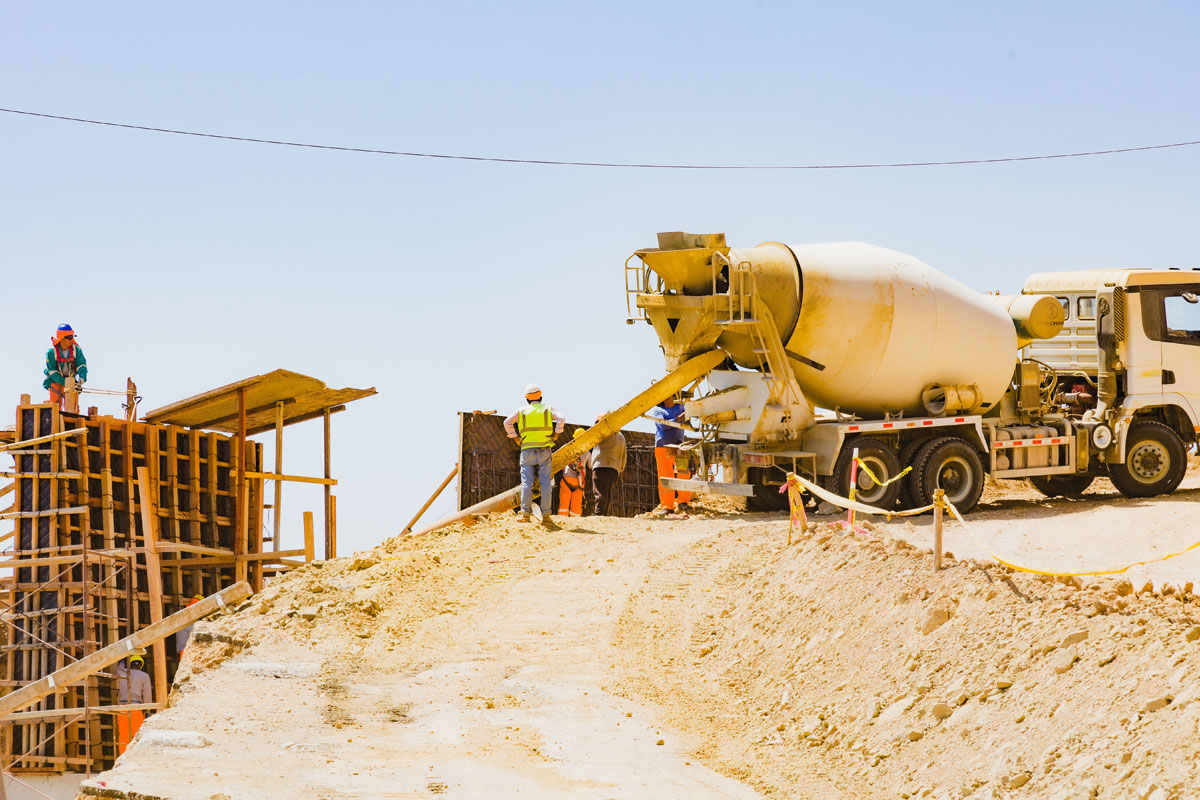
Texas runs on concrete. Every freeway expansion, every new subdivision, every refinery buildout and oilfield well pad relies on cement mixers rolling at all hours of the day and night. When one of those trucks rolls over, runs a red light, or strikes a passenger vehicle, the results are catastrophic. A fully loaded cement mixer weighs up to 80,000 pounds — twenty times the weight of a typical family sedan. The math is brutal, and the families left behind deserve a cement truck accident lawyer who knows how to hold trucking companies accountable.
CALL 281-980-4529 — FREE CONSULTATION FREE CASE REVIEW ↓
The León Law Firm has represented victims of commercial vehicle crashes across Texas for nearly 30 years. In one of our most consequential cases, we secured a $4.5 million settlement for the family of a cement truck driver killed in El Paso when his employer dispatched him in a poorly maintained mixer with no proper inspection, training, or supervision. That outcome held the cement company accountable for the grossly negligent maintenance and equipment failures that put the driver — and everyone else on the road — in danger.
If you or someone you love was hit by a cement truck anywhere in Texas, the clock is already running. Call (281) 980-4529 today for a free, bilingual case review. Hablamos Español.
$4.5 Million Settlement — Fatal Cement Truck Collision
Our client was a cement truck driver in El Paso whose employer put him behind the wheel of a poorly maintained mixer with no training, supervision, or proper inspection. The truck’s brakes failed at an intersection, leaving him unable to stop. Despite his attempts to warn cross-traffic, he collided with a passing tractor-trailer and his cement mixer rolled, striking other vehicles in the process. He didn’t survive.
Through aggressive discovery, we proved the company knew the vehicle was unsafe and had no system in place to ensure roadworthiness or driver readiness. We held the employer accountable for the grossly negligent maintenance, inspection, and dispatching that cost our client his life. The case settled for $4.5 million for his family.
Cement truck crashes don’t just kill the people hit by these vehicles. Sometimes they kill the people driving them, too. Whether you’ve lost a loved one as a third-party motorist, a pedestrian, or as the operator of a poorly maintained mixer, we approach every case with the same depth of investigation.
This isn’t a one-off. The León Law Firm has secured seven-figure recoveries in commercial vehicle and construction-related fatalities across Texas, including a $13 million El Paso train collision verdict and a $7 million delivery driver crash settlement.
Why Cement Truck Accidents Are Different
Cement mixers aren’t just big trucks. They’re uniquely dangerous vehicles, and the cases that arise from cement truck crashes involve different evidence, different liability theories, and different defendants than a standard car accident.
Top-heavy by design. The rotating drum on a concrete mixer raises the truck’s center of gravity well above that of a flatbed or box truck. Even at moderate speeds, sharp turns or quick lane changes can trigger a rollover. When a loaded mixer rolls onto a passenger vehicle, occupant survival becomes a question of geometry, not skill.
Mechanical failure risk. Brake fade is a real and frequent issue on cement trucks operating in stop-and-go traffic with heavy loads. Drum bearings fail under sustained load. Hydraulic lines burst. Each of these failures opens up a separate product liability claim or negligent maintenance claim alongside the driver-fault case.
Time-pressured delivery schedules. Concrete must typically be discharged within roughly 90 minutes of the start of mixing — a longstanding industry norm under ASTM C94/C94M, the Standard Specification for Ready-Mixed Concrete. While the 2021 revision now lets the buyer and producer set the exact time limit by contract, most ready-mix delivery schedules still operate inside this historical 1.5-hour window because fresh concrete loses workability as hydration progresses. That timer drives every decision a cement truck driver makes once the drum starts spinning. Speeding, running yellow lights, rolling stops at intersections, aggressive lane changes — all of it is incentivized by the simple fact that a load that sets up in the drum becomes the driver’s problem.
Multiple corporate defendants. A typical cement truck crash involves the driver, the trucking company, the concrete supplier, the job site operator, and sometimes a separate maintenance contractor. Each one’s a potential source of recovery. Our job is to identify every responsible party and pursue them all.
For the broader context of 18-wheeler and commercial truck accident law in Texas — including federal regulations, evidence strategy, and recent industry trends — see our complete 2026 18-Wheeler Accident Guide. These cases need to be investigated by attorneys who understand commercial vehicle litigation as a specialty, not as a sideline.

Common Causes of Cement Truck Accidents
Most cement truck crashes trace back to one or more of these factors:
- Driver fatigue. Federal hours-of-service rules administered by the Federal Motor Carrier Safety Administration (FMCSA) limit interstate truckers to 11 hours of driving in a 14-hour shift. Many cement haulers run intrastate routes that fall outside FMCSA limits, but state regulations still apply. Tired drivers cause crashes.
- Speeding to meet delivery windows. When the load is curing, time pressure overrides judgment.
- Improper loading. A drum filled beyond its rated capacity changes the truck’s handling characteristics and dramatically increases rollover risk.
- Inadequate driver training. Operating a loaded concrete mixer in urban traffic requires specialized skill. Some operators receive only a few days of training before being put on the road.
- Brake failure and mechanical neglect. Heavy loads cook brake pads. Skipped inspections turn small problems into highway fatalities.
- Failure to secure the drum. A rotating drum that slips during a sharp turn shifts the entire load and can flip the truck.
- Distracted driving. Phones, dispatch radios, and tablets pull driver attention from the road.
- Substance abuse. Alcohol, methamphetamine, and prescription pain medications all show up in post-crash testing more often than the industry admits.
Where Cement Trucks Operate in Texas
Texas leads the nation in large-truck crash fatalities, according to FMCSA’s most recent Large Truck and Bus Crash Facts. According to the Texas Department of Transportation 2024 Crash Facts Report, 4,150 people died in traffic crashes statewide in 2024 — roughly one death every two hours. A significant percentage of those crashes involve commercial vehicles, and cement trucks are a major contributor in every metro region where construction activity is concentrated. Crashes happen wherever the trucks roll, and the trucks roll everywhere infrastructure is being built — which, in Texas, means almost everywhere.
The Greater Houston region is the highest-density cement truck corridor in the state. Houston freeway widening projects, the Beltway 8 corridor, and the I-69 expansion keep mixers on the road around the clock. Just southwest of Houston, the Fort Bend County growth ring drives sustained demand. Sugar Land, Missouri City, Stafford, Richmond, Rosenberg, and Mission Bend all sit inside high-permit zones where new subdivisions are pouring foundations weekly. Even rural Fort Bend communities like Needville are seeing residential build-out and the mixer traffic that comes with it.
The DFW Metroplex is in the middle of an even bigger expansion cycle. Dallas and Fort Worth anchor a region where every freeway, every suburb, and every commercial corridor is under active construction. Cement mixers feeding the Trinity River corridor, the I-635 expansion, and the rapid suburban growth toward Frisco, Plano, and Arlington create constant heavy-vehicle conflict with passenger traffic.
Central Texas has emerged as one of the fastest-growing regions in the country. Austin permits more construction than nearly any other Texas metro per capita, and San Antonio keeps pace with military, medical, and commercial development. The I-35 corridor connecting them — passing through Waco — is itself one of the most heavily trafficked commercial vehicle routes in the country.
The Permian Basin and West Texas are a different kind of cement truck market. Oilfield concrete pours — well pads, drilling site foundations, frack water containment — keep mixers running 24/7 across Midland and the surrounding oilfield communities. Further west, El Paso handles both Permian-adjacent oilfield traffic and a steady flow of cross-border infrastructure work. Our firm has direct experience in this region, including a $369,482 settlement for a tractor-trailer passenger who suffered an arm amputation when the rig rolled on a curving mountain highway.
The Texas Gulf Coast drives cement traffic through its port and petrochemical economy. Corpus Christi supports ongoing port expansion and the refining sector. Beaumont sits in the heart of the Golden Triangle refinery corridor, where chemical plant expansions require massive volumes of structural concrete. Laredo, as one of the busiest inland ports in North America, sees relentless commercial truck flow — including the concrete mixers supporting the warehouses, distribution centers, and infrastructure that handle US-Mexico trade.
In every one of these regions, cement truck crashes happen — and The León Law Firm represents victims and families across the entire Texas footprint.

Common Injuries in Cement Truck Crashes
Because cement trucks are extremely heavy and ride much higher than passenger vehicles, the injuries in these crashes are often catastrophic rather than minor, including:
- Traumatic brain injury (TBI) and concussion
- Spinal cord injury and paralysis
- Multiple bone fractures and crush injuries
- Internal organ damage and internal bleeding
- Burns from hydraulic fluid fires after a rollover
- Amputation
- Wrongful death
If your case involves a severe or life-altering injury, please review our catastrophic injury practice for additional information on how we approach high-stakes claims. Wrongful death cases follow a separate legal track. Read more about Texas wrongful death claims.
Who Can Be Held Liable for a Cement Truck Accident
Most cement truck cases involve at least three potentially liable parties, and often more. Our investigation focuses on identifying every defendant with a viable claim against them.
The driver. Direct negligence — speeding, running lights, distracted driving, intoxication, fatigue, or operating with a suspended or invalid commercial driver’s license.
The trucking company. Vicarious liability for the driver’s actions, plus direct claims for negligent hiring, negligent training, negligent supervision, negligent retention, and negligent maintenance. This is often where the deep insurance policies live.
The concrete supplier. When the delivery scheduling itself creates the time pressure that caused the crash — quotas that can’t be met without speeding, deliveries booked too close together, refusal to add capacity during peak season — the supplier shares responsibility.
The maintenance contractor. If a third party serviced the brakes or drum and the work was negligent, that contractor becomes a defendant.
The job site operator. Cement deliveries happen on active construction sites. If hazardous unloading conditions, inadequate traffic control, or unsafe site access contributed to the crash, the site operator is in the case.
The vehicle or parts manufacturer. When brake systems, drum bearings, or steering components fail because of a defect rather than maintenance neglect, a product liability claim opens up against the manufacturer.
The number of defendants matters because it directly affects how much compensation is available. A driver’s personal insurance maxes out quickly. A national concrete supplier’s umbrella policy does not.
Texas Statute of Limitations — You Have Two Years
Under Texas Civil Practice and Remedies Code § 16.003, you generally have two years from the date of the crash to file a personal injury lawsuit. In wrongful death cases, the same two-year deadline typically runs from the date of death. Special rules may apply in certain situations, including cases involving minors or claims against governmental entities.
Two years may sound like a long time, but in practice, it passes quickly.
The most important evidence in a cement truck case — the truck’s electronic control module data, GPS records, hours-of-service logs, dispatch communications, and post-crash inspection reports — can begin disappearing within 30 days. Trucking companies aren’t required to preserve this data unless and until they receive a litigation hold letter from an attorney. The longer you wait to involve counsel, the more evidence is already gone.
We send preservation letters within 48 hours of taking a case. That single step often makes the difference between a settlement and a dismissal.
How Insurance Companies Fight Cement Truck Claims
The trucking company’s insurer will be in contact within hours of the crash. Their goal isn’t to compensate you. Their goal is to minimize what the company pays. Common tactics:
- Fast lowball settlement offers before victims understand the long-term cost of their injuries
- Recorded statements designed to lock in inconsistencies they can use against you later
- Aggressive allegations of comparative fault — Texas follows a modified comparative negligence rule under Texas Civil Practice and Remedies Code
- § 33.001, meaning if you’re found 51% or more at fault, you recover nothing
- Buried policy limits — insurers rarely disclose total available coverage voluntarily
- Surveillance and social media monitoring to challenge injury claims
Don’t give a recorded statement to anyone before talking to a lawyer. Don’t post about the crash on Facebook, Instagram, or TikTok. Don’t sign any release the insurance adjuster sends. Call us first.
What To Do After a Cement Truck Accident
If you’re physically able, take these steps in the hours and days after a cement truck crash:
- Seek medical attention immediately, even if you feel fine. Adrenaline can mask the symptoms of serious injuries. Symptoms of a traumatic brain injury (TBI) may not appear for hours or even days after the accident.
- Call 911 and ensure that a police report is filed. Be sure to obtain the police report number for your records.
- Photograph everything: the truck company’s markings, DOT number, license plate, the accident scene, your injuries, vehicle damage, and the road conditions.
- Obtain contact information for any witnesses, including their names, phone numbers, and addresses.
- Do not speak with the trucking company’s insurance representative. No matter how friendly they may seem, they are not acting in your best interest.
- Preserve all evidence related to the crash. Keep the wrecked vehicle, retain any damaged clothing, and save every medical record and bill.
- Call a cement truck accident lawyer before the company finishes its own investigation.
How a Cement Truck Accident Lawyer Builds Your Case
Our team approaches every commercial vehicle case the same way: aggressively, methodically, and with the assumption that we’ll go to trial if the settlement offered doesn’t reflect the full value of your loss.
Scene investigation. Our team begins every commercial vehicle case the same way a seasoned truck accident lawyer approaches any high-stakes matter — by sending an investigator to the crash site within 24 to 48 hours. Skid marks fade. Debris gets cleared. Surveillance video from nearby businesses gets overwritten on a 30-day cycle.
Black box and ECM download. Federal regulations require us to use formal preservation procedures to capture the truck’s electronic data. We know how to do this and we move fast.
Driver qualification file discovery. Every commercial driver has a driver qualification file (DQF) maintained by their employer under 49 CFR § 391.51. It documents their driving history, drug and alcohol testing, medical certifications, and prior violations. We get it.
Maintenance and inspection records. Trucks that shouldn’t have been on the road often have the paperwork to prove it.
Hours-of-service and ELD data. Under the FMCSA Electronic Logging Device rule (49 CFR Part 395), electronic logging devices have replaced paper logs for most commercial drivers. The data doesn’t lie about fatigue.
Expert witnesses. We work with accident reconstructionists, commercial trucking industry experts, biomechanical engineers, and economic damages experts to build cases that withstand corporate defense team scrutiny.
Carlos A. León, our firm’s founder, has personally tried trucking cases in Texas courts for nearly three decades. He’s recognized by Texas Super Lawyers and has secured verdicts and settlements totaling many millions of dollars for injured Texans and their families.
Why Choose The León Law Firm as Your Cement Truck Accident Lawyer
When you’re choosing a lawyer after a cement truck crash, you’re choosing who’ll stand between your family and a trucking company’s defense team. That decision matters.
We bring three things to every commercial vehicle case:
Track record. Nearly 30 years of trial practice in Texas courts, including the $4.5M cement truck settlement, a $13M train collision verdict, and seven-figure recoveries across the truck, oilfield, refinery, and construction sectors.
Bilingual representation matters. Carlos León is personally bilingual and communicates directly with Spanish-speaking clients throughout every stage of their case. We do not rely solely on Spanish-speaking staff members or paralegals to provide client communication.
Statewide Texas reach with national capability. Our office is headquartered in Sugar Land, but we take cement truck and commercial vehicle cases from across Texas and select catastrophic-injury matters from across the United States. Wherever the crash happened, if Texas law applies, we can help.
We work on contingency. You pay nothing unless we recover compensation for you.